
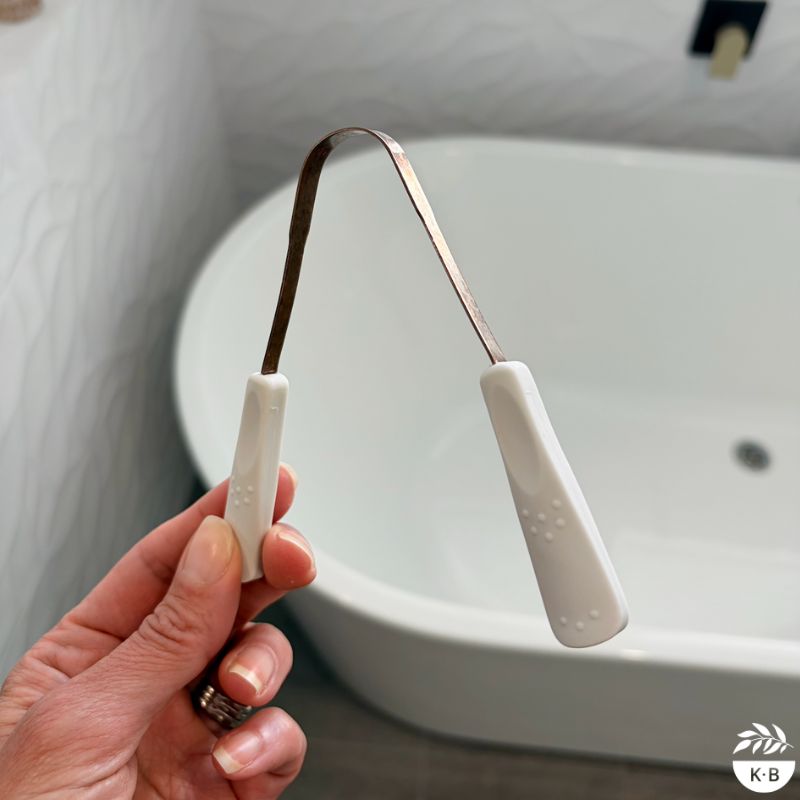
 Most of us are taught to brush and floss, but the tongue often gets overlooked.
Tongue cleaning is an ancient Ayurvedic wellness practice that helps improve taste and slows plaque formation by removing the tongue coating (source). It involves a simple tool – usually one with rubber handles and a metal or copper U-shaped cleaner – which you scrape along your tongue, from the back to the front. I usually repeat this a few times, morning and night, after brushing and flossing.
Research consistently shows that a large proportion of oral bacteria live on the surface of the tongue, especially towards the back where that white or yellowish coating can form. Regular scraping can help remove that film and temporarily reduce those odour-producing bacteria.
There is also evidence that regular tongue cleaning can reduce oral bacteria – which contributes to a healthier oral ecology, fresher breath, and reduced plaque compared with not cleaning the tongue at all.
That said, Dr Angie Nilsson notes that bad breath isn’t necessarily improved with tongue scraping, and while I understand that it can also be linked to gum and gut health, I do wonder how removing gunk from your tongue can be anything other than beneficial? What do you think?
Beyond breath, there’s also growing interest in the broader links between oral health and overall health. I can only report anecdotally that our family’s immunity has improved significantly in the years since we started scraping. Naturally, we’re very conscious of health on a holistic level, which definitely helps, but I truly believe scraping has played a role. Many people have mentioned, on my social channels when the topic arises, that they get sick less often once tongue scraping becomes a daily habit. While research in this area continues to evolve and conclusions vary depending on the lens used, these experiences are interesting to note.
So, how do you scrape your tongue?
- Hold the handles and position your tongue scraper as far back on the tongue as feels comfortable (I try to get right up to the bumpy, tender bit – you know what I’m talking about, where the surface texture changes).
- Gently press down and glide the cleaner toward the front of your mouth – this gathers the gunk.
- Rinse any gunk off the scraper and repeat a few times, until you see you’ve effectively removed the fuzz.
- Rinse and dry your tongue cleaner until next use.
- I use mine at least twice a day, sometimes more if I’m wanting a quick freshen-up without actually brushing.
Tongue scraping doesn’t need to be complicated or time-consuming – a gentle scrape once or twice after brushing takes only a couple of seconds. It’s a small but powerful habit, and one that quietly supports oral health and, potentially, much more.





2 Comments
Where can I get a tongue scraper?
Or can i just use a toothbrush or anything else that might be already in my house?
Hey Jane. Health food stores, many online retailers like Biome, Go For Zero and Clean Nectarine all stock them. You can use a spoon if you’d rather not purchase a cleaner (although I do prefer the performance of a cleaner rather than a spoon).